Turning plastic waste into clean hydrogen
Apr 22, 2026
Apr 22, 2026
As the world marks Earth Day, we highlight research enabled by Diamond Light Source that showcases how synchrotron science is driving a more renewable, sustainable future.
Plastic waste is one of the most pressing environmental challenges of our time. Plastic production has surged from 2 million metric tons annually in 1950 to over 400 million tons in 2023. Despite the global concern about plastic pollution, only 18% of plastic waste is currently recycled, while 24% is incinerated. Most of the waste accumulates in landfills or ends up in the oceans, damaging ecosystems as it persists for decades.

At the same time, there is a global need to create sustainable energy systems that produce low-carbon ways to produce fuels such as hydrogen. A recent study, published in Joule, demonstrates an innovative approach that addresses both challenges simultaneously: converting plastic waste into hydrogen fuel using sunlight. X-ray absorption spectroscopy experiments on Diamond’s B18 beamline provided key insights into how this process works at the atomic scale.
The research combines two linked processes. First, plastics such as polyethylene terephthalate (PET), polyamides, and polyurethanes are broken down by acid-catalysed depolymerisation, converting long, stable polymer chains into smaller, more reactive molecules. These intermediates are then used in a photocatalytic system, where a light-absorbing catalyst uses solar energy to drive reactions that produce hydrogen gas.
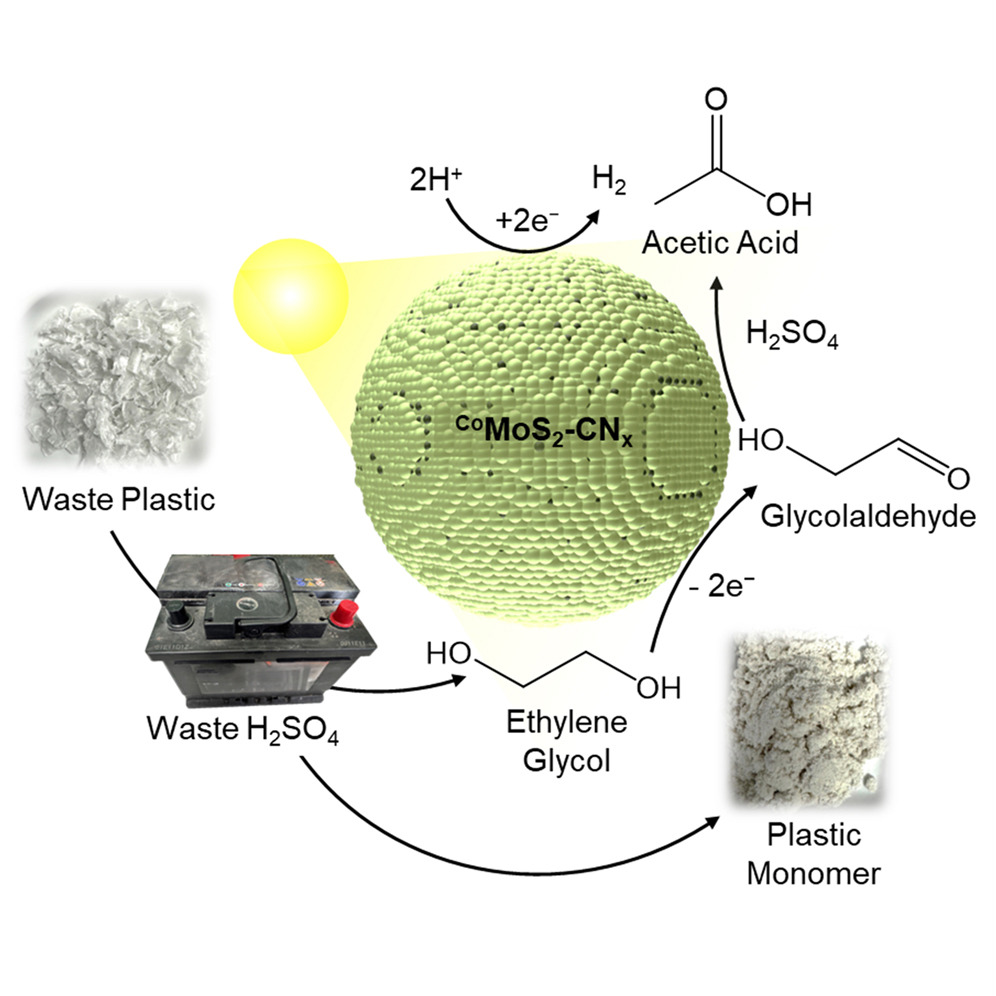
Understanding how this works at the molecular level is complex, and researchers at Diamond were able to study the reaction actively happening, allowing them to observe how the catalyst responds to light and interacts with the plastic-derived molecules in real time.
This level of detail is essential for confirming the reaction mechanism. The data showed that molecules formed during depolymerisation act as electron donors, undergoing oxidation at the catalyst surface, while protons are reduced to form hydrogen gas, demonstrating efficient coupling of plastic oxidation and hydrogen evolution.
It also showed the catalyst remains stable under reaction conditions, maintaining its structure and activity over time, which is an encouraging sign for large-scale applications.
The paper highlights how synchrotron science helps to tackle real-world problems, enabling researchers to visualise chemical processes at the atomic level.
The findings highlight the power of synchrotron science in tackling complex, real-world problems.
By enabling researchers to visualise chemical processes at the atomic level, facilities like Diamond Light Source help bridge the gap between laboratory discovery and practical application.
This work represents a step towards more sustainable chemical technologies, turning waste plastics into fuels and chemicals using renewable energy. With further optimisation and scaling, it could help reduce plastic pollution and support the transition to clean energy.
Read the full paper online: Solar reforming of plastics using acid-catalyzed depolymerization | Joule

Diamond Light Source is the UK's national synchrotron science facility, located at the Harwell Science and Innovation Campus in Oxfordshire.
Diamond Light Source Ltd
Diamond House
Harwell Science & Innovation Campus
Didcot
Oxfordshire
OX11 0DE
Copyright © Diamond Light Source. Diamond Light Source® and the Diamond logo are registered trademarks of Diamond Light Source Ltd
Registered in England and Wales at Diamond House, Harwell Science and Innovation Campus, Didcot, Oxfordshire, OX11 0DE, United Kingdom. Company number: 4375679. VAT number: 287 461 957. Economic Operators Registration and Identification (EORI) number: GB287461957003.